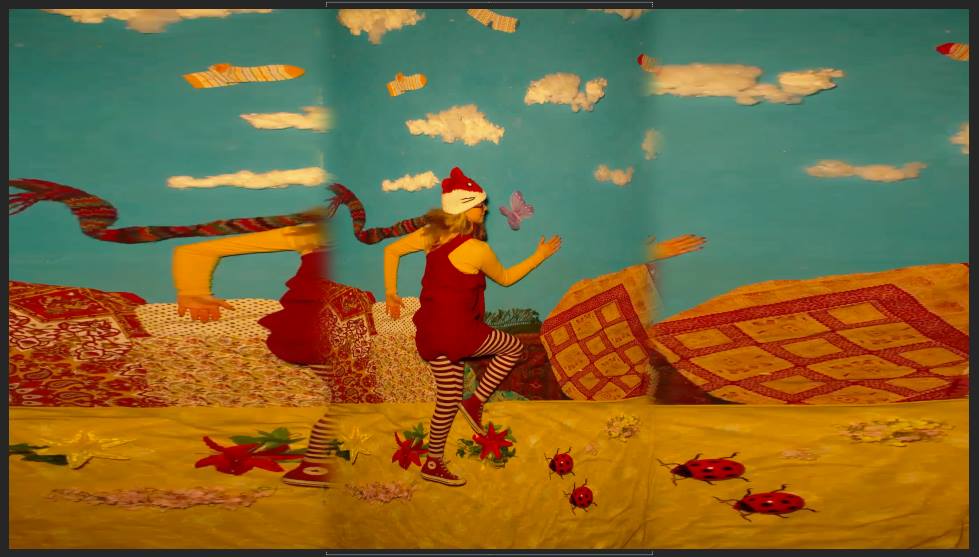
After filming we had a group meeting and edited the piece together, it was at first difficult to work out how to edit each image without having to do them individually. We where trying to recreate this image that Cassie had produced on photoshop.
We played around with batch editing for a while, however, we realised that it would be much easier to animate it straight into photoshop.
Also it was this session that I had first heard the music that Jerry had created. Especially how well the more playful child like tones worked at the start, it still needed some slight tweaking so it would fit, but we where all really happy with the progression of the film. Finally seeing the finished piece with the sound really emphasised the message that we where trying to convey through our film.
When editing we felt that the message in our film was getting lost. Although visually I feel our film looks amazing, the focus seems to be on the bright exciting part, as that is the longest section. However, the concept of our film is about people falling into a state of ennui. We needed to reinforce this cycle of the mundane life that people get trapped in, and the only way to do this was with the use of looping the ennui section until the film gave the audience that emotion!
Understandably it could backfire as people could not understand the message and become bored of our film, however, what better way to portray an emotion than to make the audience feel it, and with this module, now is a time more than ever to experiment.
I have done some more visual research into films that use the looping effect and to see how we can draw similarities to ours.
This animated film is called Revolver, and it was one that came to mind when talking about loops and cycles. The concept of the film is rather strange and I am not fully sure of what it is, but for some reason I find it so interesting to watch. Even though it is just a repetition and the same animated sequences, the timings and sound design makes it so interesting to watch. I feel as though we will have a similar effect with the music that will be added onto our film.
I picked this film because of the loop that is portrayed at the end. I feel that it really emphasises the message of a circle of life feel. This again reinforces the message of looping the ending of our film to make sure the audience completely understand the message.
On the day James and I filmed a time-lapse of us creating the pixilation, sadly it was filmed on my phone, and becasue I had used tape to prop it up, over time it began to slip down without us realising. Hence the weird camera movement in the video. I then send them James and he composited them into a video on youtube. It was really interesting to see the progression of the piece. Although a lot of the time was spend discussion our next move!
We decided that our film needed to be shot vertical rather than horizontal, as the space needed to shoot our films meant that when the actress was standing part of her body would be cut off. An idea we had was to add graphics onto the side of the piece, or maybe even a kaleidoscope effect.
(an example done by James as he experimented with ways to create the horizontal film, before we had the idea of Vertical Cinema)
I partly feel that this will look like an after thought and could look like a rushed job added to our piece and that it is unnecessary. I have done some research into Vertical cinema and feel that perhaps this will work to our advantage.
A special effect expert called Tim Webber who has worked on films such as Children of Men, Gravity, and Where the Wild Things Are, was asked his artistic opinion on the effects vertical cinema has and he was quoted saying
The artistic and aesthetic differences are really where vertical cinema is interesting. Landscape filmmaking automatically lends itself to having more people in the frame at once. How people interact, and the relationships they have with one another, are a key narrative point to the majority of films we see today. With a portrait frame, however, it’s much more suited to having one person dominate the screen. As a result, the type of film we’d see with this technique would be different to the norm.
Considering we have only on actor on set at the entire time, and the focus of out film is on their life and their experience it makes sense to keep the film vertical to include this effect. Similar to my previous post about the fish eye lens camera adding the intensity, as that was not a possibility to do any more I feel as though this would be a good alternative.
In the article he was further quoted saying
'...in vertical cinema the environment tends to have a far greater effect on the character. So, if the sky plays a big role in your film thematically or through the narrative, a vertical frame would be the perfect fit.
Another thing that is massively importing in our film, is the environment as it expresses her mood, and is also a metaphor for her mental age. Something very important to us is that the environment to be bold and noticeable, and I feel this will be done better by the use and experimentation of vertical cinema.
On the first day of filming we encountered many problems. We set the camera up on a C-stand and the FTU set up a light on the rig above the set. Originally we tried to use many of the smaller lights but found they cast too many shadows in different directions so we decided to settle with the one. While taking test photos, we found that the camera lens would not focus properly, however, as this was only the half day we booked we had only planned to set up ready for the next day so it wasn't too much of a big deal. This day was more about the preparation, and practise shots than the actual full shoot, so a lot of the time was spent dressing the set.
Once we got the new camera and began properly animating we realised that animating in 12fps would not work, as the speed of the piece was far too fast, so we decided that 8fps would work better.
As we progress with the filming of our piece, it all began to take form and visually looks amazing! Although some scenes seem to be animated a little fast, this is due to us all animating together, sometimes we had to make sure we each had an individual objects to animate or the next person might do it different to the previous, but over all we where happy with the progress.
After James put the film together for us the Sunday night, we did notice that the end scene with Imogen walking looked wrong in the loop. We decided that the following day we would re film that part.
We struggled to correctly animate that final walk as we wanted it to express Imogen's emotion, or lack of emotion. Finally we decided that as the start of our piece already included a walk cycle that perhaps it would be more interesting to include something different. So we came up with the idea of hanging Imogen from the cloud above her, and that would be the section for the adult loop.
I am really happy with the change as it created a much more exciting effect than just returning back to the original walk cycle.
These videos are the unedited format, we have yet to edit the colours and images in the pixilation.
When the final stage of adulthood is present, we really needed something to break the cycle that was full of colour and excitement, to break from her daily norms. Here are some video we found that express that feeling.
This is the commercial called 'Balls' shot for Sony. The reason I feel this is good research is as at first it seems as though it is just a normal mundane setting as we see a normal city. However, it is suddenly immersed with colours and excitement as thousands of bouncy balls fall down the streets. As bouncy balls are toys for children, while watching this film we get a feeling of nostalgia, as well as the amazing visual excitement, and this is something we want to recreate when the actor breaks free from the mundane routine in our film.
Their intention of this film was to sell their product by 'connecting with the consumers at an emotional level'. Which again is something we want to achieve with our film.
Another piece of research that has influenced the mood for our piece is this Cadbury's advert 'Unwrap Joy'. We really liked the natural excitment that is shown on the children's face as they unwrap the houses, and it is that kind of natural emotion that we wanted our actress to express at the end of the piece as she is covered in paint. Like this advert does, we wanted the audience to understand that joy and also feel connected to the emotion in our piece.
When doing a test run the week before shooting, we encountered a problem with the angle of the bike and the camera. We could not get the bike to sit in the right position, so we made the drastic decision to cut the bike from the film, and re work the story. We wanted to keep the concept the same, a child loosing excitement and imagination as it ages and reaches the adult stages of life. However, without the bike it allowed us to create much more movement in the piece, as the actor was not restricted by the bike being on top of her. After making some minor changes a quick story board was drafted up, instead of the flip on the bike, she would now fly up into the clouds and when she reaches the adult stages of life her wings would fall off and she would fall back to earth, which would now be all gray and boring. The cycle of adulthood would still remain, and at the end it would rain, and as the rain drops touched her, they would create splotches of bright paint on her plain white clothes, explaining that you can still find the excitement of youth in your life, you just need to break from the cycle.
For our film we spent a while deciding on whether or not we wanted
to film in 12 fps or 8 fps. We felt that perhaps we should start in 8 fps and
then alter to 12 fps so the audience is aware of the change to feel confused
and disjointed by the pixilation at the start of the film where the audience is
viewing the children's point of view. This uncomfortable feeling will challenge
the audience's views of childhood being uneasy, however, it is still a more
exciting option that adulthood because of the bright colours, expressing that
this vibrant lifestyle is more rewarding is the more difficult path than the
boring adulthood circle.
When we practised putting this idea into action we realised that it
partly looks as though we made a mistake while filming, but also it was
difficult for us as animator to alter our brains into animating on a different
frame rate, and would repeatedly make mistakes while animating after we swapped
over the frame rate.
So after we decided to pick one frame rate to animate in throughout the entire film, to decided which to pick we did some quick test shoots in both frame rates.
We felt that 8 fps, although it had a nice pixilated effect it was
too jiggered, so we decided on 12 fps, as it is also what us as animators
normally animate in so we understand the timings and speed.
To sort out timings I said I would create a really quick animatic just so we could see exactly what happens where and also where we could place all our ideas, so we could see a clear timeline that we could start adding our idea to. I didn't want to focus too much on colour and the patterns as I felt that was something we needed to decide as a group. After finishing the quick animatic, I did notice there were sometimes long pauses, and I understand that when we come to animate it the background will be moving, however, I do think there needs to be more action, so perhaps the changing of paths ideas will fill that gap. Also at the end as we have not yet decided on what the repetitions scene will be I have just left that part blank.
Also this means that we can start with the sound now we have a more clear passage of events.
In the music video Tove Lo - Habits (Stay High) - Hippie Sabotage Remix I really love the fish eye lens effect, I think it really bring a kind of intensity to the piece as though you are with the girl, following her through he repetitious violent cycle of repeatedly going out to drink to forget how she really feels, you almost feel uncomfortable close as you watch her. It appears as though she is having fun, although there is definitely as sinister underlying tone that comes out towards the end.
After looking into fisheye lens more I have found out that they are used in photography to gain an ultra wide angled shot, which could be helpful as we are also worried about space as we only have as high as the ceiling to shoot the piece. The name for the lens was created by and American physicist and inventor named Robert W. Wood in 1906, and it is based on how a fish would view the world, and now they are generally used for their distortion.
If it is not possible for us to use this lens there is the chance that one of our members has a gopro which she said also give off a similar effect, also I know of an effect in after effects that we would be able to use to also create this effect.
After the meeting we collaborated our ideas together and created another brief animatic, although the software we had hoped to used was no longer installed on the university computers, so we struggled to make it using after effects.
This time we focused more on the adult life, and we came up with a really good idea of creating this cycle and loop throughout, we wanted the audience to experience this repetitious effect of life as well with the character, so we though by making it loop until the point that the audience similarly to the character where feeling this drained cycle effect. To end it and break the character out of this cycle we wanted something to happen, to remind the character of the love they once had for their life, we though by making them look up at the clouds like they did when they where a child, would reinforce this, and the sky would rain and reveal a yellow path, like the one they road on when they where young.
During the meeting with Sarah, she showed us this short animated film called Father and Daughter, I really liked how we saw the life transition throughout her bike ride, and how at times she was joined by others, or rode her bike differently as she aged. The way the film managed to create this believable world where it seemed people lived on bikes, just by these small techniques is definitely something worth considering for our film. I think it would be a good idea to experiment with how the actor rides the bike to show their life development.
Other things mentioned where perhaps if different paths appear throughout the character's life, I also like this idea as it shows the character isn't just following a path but actively choosing which course to take, as we want the film to be about the characters decisions that cause this loss of excitement in life we need to show that they are choosing this path, not just following it.
I also quite like the idea of starting off the bike and getting on, as this symbolises the character being born, and also by getting off the bike this symbolises the end, creating the bike to be more of a metaphor for life and death, and the journey people take.
We had a non compulsory stop motion workshop as part of our animation course, stop motion is something I have always been interested to looking into further, however, as in introduction we had to complete a pixielation in a group.
This was great practise for our upcoming experimental film, as it meant we could begin to understand what we could accomplish in a set time and also skills needed to make it a high quality piece of work.
This is the finished piece from the workshop, and although we have been a little worried about making sure we get everything finished in the set time, we have decided that we may animate on 12 fps or possible 8, to get the jagged pixielation effect, meaning this would also speed up the process. This is something we want to look into practising as a group.
While doing more research I found this short film, expressing how children view the wars in Gaza, this is something we have not yet thought about, that as a child everything isn't just pure excitement, and that things can seem very threatening at times. Perhaps the harshness of the sound will represent this, however, I do think it is worth considering some different angles to express the life as a child, as they grow and begin to understand more about the world, things perhaps become darker as they realise that people lie and hurt each other. This may give us a different angle, as to not just the superficial things that make life dull, such as paying bills and taxes. So our message could still be representing how children have huge imaginations, but they're not always thinking about happy things.
In this film I particularly like the use of the children's style drawings and the narration being done by children, as the audience it makes you feel guilty for subjecting such innocent children to such horrific news. Perhaps if we have a stronger more meaningful way of impacting our message it will cause the audience to think about our film more, however, I do thing a big part of that will be done with the sound.
While doing some video research, I found this short film, I really like the perspective used, as when you are a child everything seems so much bigger. Also as we wanted to show how time passes longer when you are a child, this could represent how everything seems bigger/longer when you are a child. It might be interesting to experiment with objects in the pixielation and how we could make things appear bigger, then smaller as the character grows to show this passing of time from childhood to adulthood.
We met as a group and drafted up our first initial animatic, as we spoke through ideas, and messages we wanted the audience to get from our film. The main message as it stands is to show how we lose our imagination and excitement for our lives as a child becoming an adult. However, at the end we want to express to the audience that it is still possible to bring back this enjoyment for life, by using little windows with colour emitting from them.
This is a screen shot of a collage we made so we could put our ideas together on a basic time ling so we could understand the progression of our film
While exploring different ways to incorporate different styles of animation into our pixilation, I had an idea that was similar to the Augdemented Reality videos, in the we could physically add cell animation into the pixielation as it is shot frame by frame.
The John Lewis Christmas advert from a couple years ago did something very similar to that, in that they created a film by animating cell 2D animation and printing out the physical images and placing them on a stop motion set.
The style of animation used in this short is very stylised as they had a Disney animator to help, I was thinking for our film we could use more of a style used in Augdemented Reality, however, the concept is really clever.
I believe this is the first time this style of animation, incorporating 2D and stop motion has been done before. It is a technique that adds a real sense of depth into the animation, and although we will be filming our pixielation on the floor so we wont get that 3D effect of the background, however, it might make for an interesting contrast of animation styles.
This is a pixilation, the reason we have looked at this video is because of the use of the bike. We were worried about how a bike would look lying flat on the floor, and whether or not it would be effective enough, or look like a fallen over bike. In this short it works really well as it genuinely looks like he is riding a bike. We began to suspect that perhaps it was filmed using a green screen, however, at the end it shows a short clip of how they made it, and it was all filmed in the pixielation method.
You and I
Here is another very similar pixielation we looked into, as they also use a bike, however, in this film instead of using a real one they make a fake frame using real tires, giving the impression of a bike. I feel this works really well, and perhaps if using a real bike doesn't work this is always something we can test out. I also like the using of everyday things creating exciting things, like the t-shirts as birds, and the sock representing a dragon, I think if we are to express the imagination of a child this is a technique we could also use.
Amazon Kindle Commercial
Another pixilation from above, it is interesting to see how this style of animation has been used for main stream commercials, similar to the 1987 film The Way Things Go and the Honda Cog advert, as experimental films find these new techniques and as they can create such exciting visuals, commercial companies want to use them. This is also a useful short as the concept of it is to represent peoples imaginations as they read, similar to our concept of representing a child's imagination. Also it is interesting to see how they have used a bike, and the different ways of sitting on one.
Bikes Make Life Better
Another member of the group had the idea to incorporate bike tricks like these, as the character reaches their 'teenage stage'. As we had the idea to change the bike into perhaps a horse on a stick when they are a child, showing how vivid their imagination is. However, as they reach the 'teenage stage' they lose this imagination but they haven't lost their fun and thrills in life. We realise this might be difficult to achieve, however, it is worth experimenting with.
I am really excited at the prospect of animating a pixilation, as an animation student I spend lots of my time animating 2D digital, so the thought of animating something physically makes a nice change from what I usually do and gives me a chance to really experiment.
Our current idea is that we are going to have a person riding a bike, this will be in the form of a pixilation, the character will be lying on the floor as the pictures will be taken from the ceiling, allowing us to manipulate the floor as the background. We will use bright colours and exciting fabrics to represent the child like stages of life, and as the child grows up we will represent this by changing the fabrics to a more boring, dull colours.
After the meeting with Sarah I feel more positive about the idea, as she agreed that it is far less complicated than the previous idea and is more possible to achieve.
Our plan of action is currently:
to gather as many research videos as possible relating to the idea;
to then think of clever quirks we can add to our film, for example broccoli for trees when the character is a child;
to create some test shoots so we can test what works and what doesn't;
and finally to create a detailed animatic so when it comes to filming we know exactly what we are doing and when, so it can run as smoothly as possible.
After meeting with the group we decided that although we all liked the idea and felt strongly about it, it was becoming too complicated and it would be difficult to get across the message across as we where trying to explain so many different things.
Instead we all decided what was our favourite part of the idea, and that was the idea of how a person loses the excitement they once had in their lives when they where a child.
We then had the idea to use something to represent how people progress through this cycle of life, and thought it would be interesting to snap back to a bicycle wheel. We all agreed we liked this concept of the bike, and thought what if we make the piece more metaphorical and had someone riding down a country lane with it heavily animated at the start to represent their childhood, and less animated towards the end to show how their life has become more boring and mundane as they get older.
We liked this idea and found some research videos
Ribena
As we thought about what we wanted to animate, for example broccoli for trees, we thought perhaps we could use a collage style animation, like that used in this ribena advert. As they use existing images and animate movement onto them.
E4 Ident
Following on from that we discussed how we like the style of animation in the E4 idents, this is simply just stop motion, and to recreate this using a person on a bike it would require pixilation.
However, we realised the difficulty of trying to create a pixilation piece with the use of a person on a bike, as it would mean they would have to balance the bike in order to take the photograph.
Then we posed the idea of having the character on the bike lying on the floor so the pictures will be taken from the ceiling, that way we can play with fabrics and items on the floor to make the background. This is a common thing used in pixilations as it allows for an easier way to manipulate the background.